
Introduction
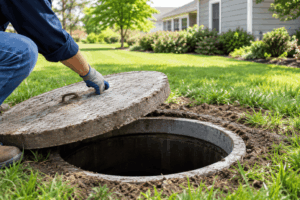
Most homeowners can tell what’s wrong with their roof, their HVAC, even their gutters, but ask them what’s happening three feet underground in their septic tank right now, and you’ll get silence. That silence is exactly where the problem lives. A septic tank doesn’t announce when it’s failing. It just keeps filling, quietly, until the day it doesn’t. By then, a simple maintenance call has become a drain field replacement, raw sewage exposure, and a system that’s compromised far beyond what routine service could have addressed.
Gateway Septic has worked with homeowners across Skagit County since 1976, and the calls we dread most are the ones that should have happened two years earlier.
This blog covers the real, technical difference between septic pumping vs cleaning, what each one does inside your tank, what Western Washington’s environment demands from your system, and the warning signs that mean you’re already behind schedule.
Understanding Your Septic System
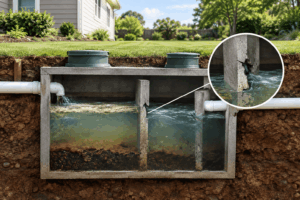
Your septic tank is not a storage container; it’s an active treatment system. Inside the tank, wastewater separates into three distinct layers. Grease and lightweight materials come to the top and float as scum. The heavier solids settle and compact to form sludge at the bottom. The middle layer is liquid, called effluent, which flows out to the drain field where it is filtered by the soil.
That separation only works if there’s enough room in the tank for it to occur properly. If the layers of sludge and scum are too thick, the effluent cannot separate cleanly. It carries solids to the drainfield, plugs up the soil, and permanently ruins the filtration zone.
This is not a slow, forgiving process. Once a drain field is compromised, it cannot be “pumped back to health.” It typically requires full replacement.
Septic Pumping vs. Septic Cleaning: Key Differences Explained
These two terms are used interchangeably by homeowners, but they mean two completely different processes.
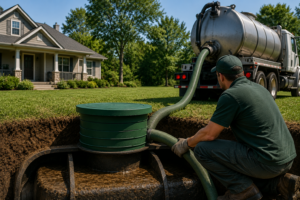
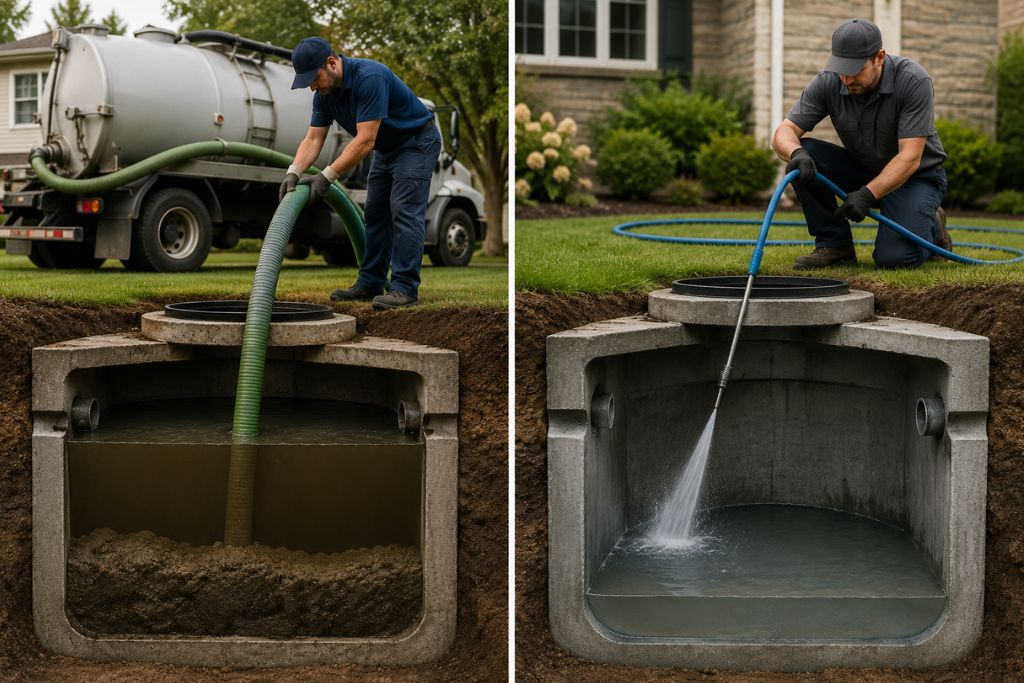
Septic pumping uses a vacuum truck to suction out the liquid waste and the floating scum layer from your tank. It’s the most routine form of maintenance, and when done on schedule, it’s highly effective. What pumping doesn’t take out is the compressed sludge at the bottom of the tank, especially sludge that has hardened and stuck to the walls over the years.
Septic cleaning goes further. It involves breaking down and fully extracting all residual waste, including that compacted bottom layer. The technician agitates the sludge, rinses the interior walls with water, and ensures the tank is cleared end to end.
| Septic Pumping | Septic Cleaning | |
| What it removes | Liquid waste + floating scum | All waste, including compacted sludge |
| Typical frequency | Every 3–5 years | As needed, based on buildup |
| Best suited for | Routine, on-schedule maintenance | Long-overdue tanks or first-time service |
| Drain field protection | High, when done regularly | Higher: removes sludge that pumping misses |
One of the main causes of premature drain field failure is a lack of cleaning when pumping is not sufficient. For septic tank pumping in Skagit County, what your system actually needs depends on how long it’s been since the last service and what the technician finds inside.
Hard Truth: A septic tank that hasn’t been serviced in over five years almost certainly needs cleaning, not just pumping. Pumping a neglected tank without addressing compacted sludge is like changing the oil in an engine without ever flushing it.
Why Both Septic Pumping and Cleaning Are Essential
Here’s what most people don’t realize: sludge doesn’t stop accumulating between service visits. It compacts. With every year that your tank is not serviced, the effective working volume is diminished. A 1,000-gallon tank with 400 gallons of hardened sludge at the bottom is really a 600-gallon tank, and it will fill up and overflow well ahead of what the manufacturer or county health department thought when they set your maintenance schedule.
The consequences are not just inconvenient. They are:
Drain field failure: The most expensive single outcome of a neglected septic system, often requiring full replacement
Groundwater contamination: In Skagit County, this is both a health risk and a regulatory concern
Sewage backup: Raw waste entering your home through floor drains, toilets, and sinks
Structural tank damage: Gases produced by compacted anaerobic sludge accelerate corrosion in concrete tanks
For homeowners in Stanwood, Mount Vernon, Oak Harbor, and Sedro Woolley, these aren’t hypothetical outcomes. They’re what happens when the maintenance calendar gets ignored long enough.
Signs Your Septic Tank Needs Pumping or Cleaning Right Now
Your system will communicate before it collapses, but only if you know what to look for. Here are the signs that your tank is overdue:
Drains are slowing across multiple fixtures: Not one clogged drain; the whole house is draining slowly at once
Gurgling from pipes after flushing: Air displacement caused by a tank that has nowhere to push waste
Sewage odor indoors or near the drain field: Gases escaping through tank lids or saturated soil
Soft, wet spots in the yard above the drain field: Effluent surfacing because the field can no longer absorb
Toilets flushing sluggishly: Especially combined with any of the above
Any one of these symptoms warrants a call. Two or more together means the window for routine service may already be closing.
How Western Washington’s Environment Affects Your Septic Maintenance Schedule
The common advice to pump every three to five years was not written with Western Washington’s rainfall patterns in mind. One simple reason why septic tank cleaning in Western Washington often needs to be on a tighter schedule: saturated soil.
What Heavy Rainfall Does to Your System
When the ground around your drain field is consistently wet, its capacity to absorb and filter effluent drops significantly. A drain field that can handle your household’s output under normal soil conditions is under much heavier demand during prolonged rain. If the tank is running fuller than it should be, then the two problems compound each other quickly.
Clay Soils and Slow Drainage
Much of Skagit County sits on clay-heavy soil, which drains poorly under the best conditions. For homeowners in areas like Stanwood, WA, and Sedro Woolley, this means your drain field is doing harder work than it would in a sandier region. A tank that is even moderately over-full puts it at real risk.
The Practical Answer
In Western Washington, many households benefit from servicing every three years rather than five, particularly larger households, older systems, or properties with clay-heavy soil. This is something Gateway Septic assesses directly during service, and we’ll tell you what we actually find rather than defaulting to a generic recommendation.
What to Expect When You Book a Septic Service with Gateway Septic
We inspect before we pump. That distinction matters.
When you call us for septic pumping in Burlington, WA, or anywhere across Skagit County, our technicians don’t arrive and immediately start suctioning. We start with a tank assessment, sludge and scum layer depths, inlet and outlet baffle inspection, and signs of damage or root intrusion. That assessment will tell us if the pumping is enough or if your system needs a full cleaning.
We’ve been doing this since 1976. We’ve seen what happens when a technician skips the assessment and pumps a tank that needed far more than that. We don’t cut those corners.
The Bottom Line: What Your Tank Needs, and When
Understanding septic pumping vs cleaning is not just technical knowledge; it’s the difference between maintaining a system and replacing one. Pumping handles routine buildup. Cleaning addresses what years of deferred maintenance leave behind. And together they protect your drain field, prolong the life of your tank, and keep your household running without incident!
At Gateway Septic, we’ve completed over 1,600 projects for homeowners throughout Skagit County. Whether you need septic tank pumping in Skagit County, a first-time assessment, or a full septic tank cleaning in Western Washington, we’ll tell you exactly what your system requires, and we’ll do it right.
We serve Burlington, Mount Vernon, Stanwood, Oak Harbor, Sedro Woolley, and the surrounding Skagit County area. If your tank hasn’t been serviced in the last few years, the time to call is now, before the system makes that decision for you.
Call Gateway Septic today: 360-826-5520. Reach out online at gatewayseptic.com to request a free estimate, and get ahead of the problem before it gets ahead of you.