
A septic system doesn’t send calendar reminders. It doesn’t warn you before it backs up into your home, floods your yard with contaminated wastewater, or silently destroys the drain field you’ll eventually pay a fortune to replace. By the time most people realize something is wrong, it’s too late for a quick fix, and a manageable repair has turned into a choice between a major intervention and a complete system replacement.
At Gateway Septic, we’ve seen this play out more times than we’d like, and every single time, the outcome would have been different with earlier action.
This blog explains the key differences between repair and full replacement, what causes each, how to identify which one your system needs, and why the timing of your decision matters more than most homeowners realize.
Understanding Your Septic System Before Making Any Decisions
Most people know their septic system is “somewhere in the backyard.” But knowing what makes it work is what separates the homeowner who catches a single component problem early from the one who ends up with a total drain field failure.
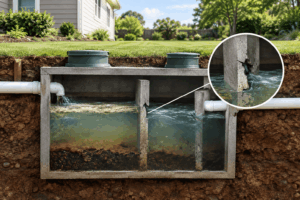
Your system has four core components working in sequence:
| Component | Function |
| Septic Tank | Separates solids, liquids, and scum |
| Baffle | Prevents solids from reaching the drain field |
| Distribution Box | Evenly distributes effluent across field lines |
| Leach Field | Filters and disperses treated wastewater into soil |
When one component fails, it doesn’t fail in isolation; it stresses every component downstream. A broken baffle pushes solids into the distribution box. A compromised distribution box overloads one section of the leach field. A saturated leach field? That’s where replacements begin.
Common Septic Tank Problems That Lead to Repair or Replacement
Septic systems don’t fail randomly. There are predictable, well-documented patterns of failure, and knowing them keeps you ahead.
According to the U.S. EPA, over 2.5 million septic systems across the country are currently failing. The top reasons aren’t freak accidents; they are years of skipped pumping, ignored early symptoms, and improper use piling up until the system can no longer compensate.
The most common culprits:
Infrequent pumping: Allows solids to accumulate and overflow into the field
Tree root intrusion: Cracks tanks, pipes, and distribution boxes over time
Heavy water usage: Overwhelms the leach field’s absorption capacity
Outdated or non-code-compliant design: A problem especially common in older Skagit County properties
Physical component degradation: Baffles, lids, and distribution boxes crack with age
The real cost of ignoring your septic system isn’t the repair; it’s the replacement you’ll eventually have no choice but to do.
Signs That a Septic Tank Repair May Be Enough
Repairs are quite feasible if the damage is localized and the basic structure of the system is intact. Search for:
- Slow drains or gurgling sounds in multiple fixtures
- Mild odors near the tank, not throughout the yard
- Pooling near the access lid after rain
- A single-component issue confirmed by inspection
Systems under 15 to 20 years old with a consistent maintenance history are almost always repair candidates. Cracked lid, bad baffle, or uneven distribution box. These are things you can fix without tearing up your yard.
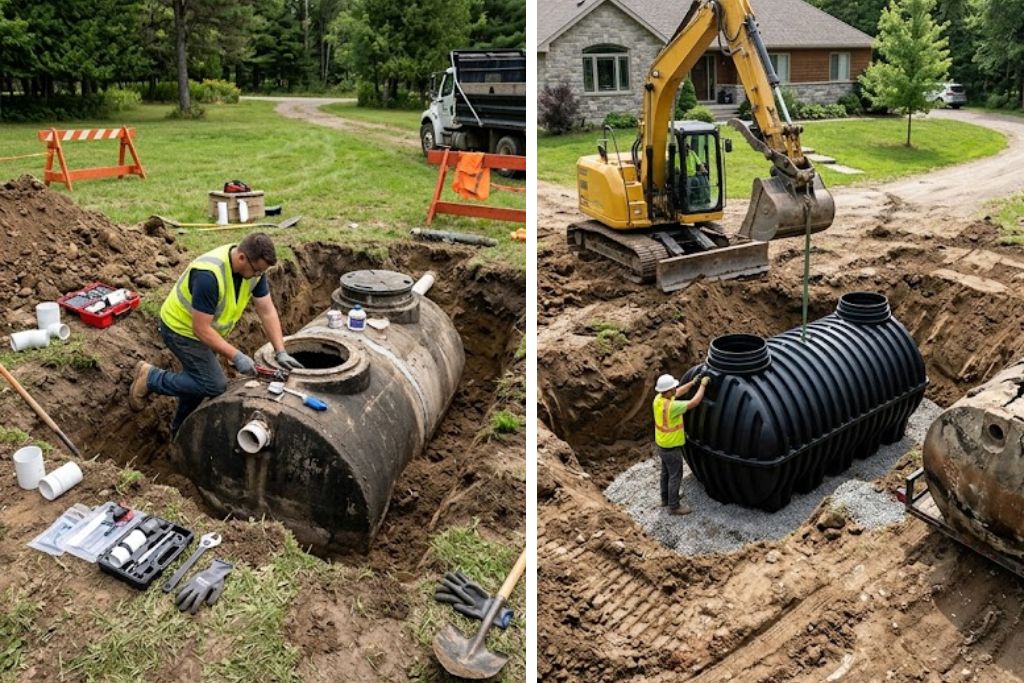
Signs That a Full Septic System Replacement Is Necessary
Some situations can’t be patched. Full replacement becomes the only responsible path when:
- The tank is structurally compromised, with cracked walls and collapsed sections.
- The leach field has failed, saturated, root-damaged, or biologically dead soil.
- You’ve had repeated repairs on the same system with diminishing results.
- The system predates current code requirements and cannot be brought into compliance.
- There is confirmed soil or groundwater contamination.
This is where the septic tank repair vs replacement decision becomes critical. Fixing a system that really needs to be replaced just pushes the inevitable back a little, and each month of delay makes the damage worse.
Repair vs. Replacement: A Side-by-Side Comparison
| Factor | Repair | Full Replacement |
| System Age | Under 20 years | 25+ years |
| Damage Scope | Isolated component | System-wide or field failure |
| Timeline | Days | Weeks |
| Disruption | Minimal | Significant excavation |
| Long-Term Value | Strong, if system is structurally sound | Eliminates recurring failures |
Understanding septic replacement cost in Washington State starts with understanding your system’s actual condition, not just the visible symptoms. That’s precisely why inspection is not optional; it is the basis for every smart decision.
The Role of a Professional Septic Inspection in Making the Right Call
Here’s what surprises most homeowners: the symptoms of a failing septic system rarely tell you what’s actually wrong. A slow drain may be a clogged pipe or a saturated leach field. Odors could be a cracked lid or the start of field failure. If you don’t check it properly, you are guessing and guessing wrong. This can become expensive.
A professional inspection evaluates:
- Structural integrity of the tank and all components
- Baffle and distribution box condition
- Leach field performance and soil saturation levels
- Compliance with the current Washington State code
- Pump-out history and how it’s affected the system
At Gateway Septic, our inspections are so thorough that we often tell clients that their tank is not ready to be pumped, saving them unnecessary service costs. That honesty is what’s kept us trusted across Burlington, Stanwood, Mount Vernon, Oak Harbor, and Sedro Woolley since 1976.
Your septic system will give you warning signs. The only question is whether you’ll act on them or wait until it decides for you.
Don’t Wait Until It’s an Emergency: Act Early and Save More
There’s a pattern we see repeatedly in septic system repair in Burlington, WA, and across Skagit County: homeowners notice something’s off, assume it’ll resolve on its own, and call us months later when it’s twice the problem. By that time, what should have been an easy fix turns into field damage, structural compromise, or total system failure.
Warning signs that demand immediate attention:
- Lush, unusually green grass directly over your drain field
- Sewage odors inside your home, not just outside
- Multiple fixtures are draining slowly at the same time
- Standing water or soft, wet ground over the leach field
- High water levels are visible in the tank during routine checks
If you’re in Stanwood, Sedro Woolley, Oak Harbor, or anywhere across Skagit County, and any of these sounds familiar, don’t wait. Septic tank repair in Stanwood, WA, handled early is a fraction of the disruption of emergency replacement. Routine pumping every 3-5 years and periodic inspections really is the one thing you can do to prolong the life of your system and avoid forced replacement.
The Bottom Line on Repair vs. Replacement
Whether repair or replacement is the right path comes down to three things: the age of your system, the scope of the damage, and whether the core structure can realistically support another decade of use. A failing baffle on a well-maintained system is a repair. A tank decades old with a saturated leach field and a cracked distribution box is a replacement, and spot fixing will not change that outcome.
The septic tank repair vs replacement decision is never black and white, and it should never rest on surface-level symptoms alone. At Gateway Septic, we’ve spent decades diagnosing exactly these situations across Burlington, Stanwood, Mount Vernon, Oak Harbor, Sedro Woolley, and the wider Skagit County area. Every septic system replacement in Skagit County we’ve handled, every septic system repair in Burlington, WA we’ve completed; it all comes back to one thing: giving homeowners an honest picture of what their system actually needs, not what’s easiest to sell. If you’re weighing your options or trying to understand septic replacement cost in Washington State, start with the facts. We’ll help you get there.
Don’t let a manageable problem turn into a system-wide failure. Call Gateway Septic today at 360-826-5520, and let’s figure out exactly what your system needs before it makes the decision for you.