
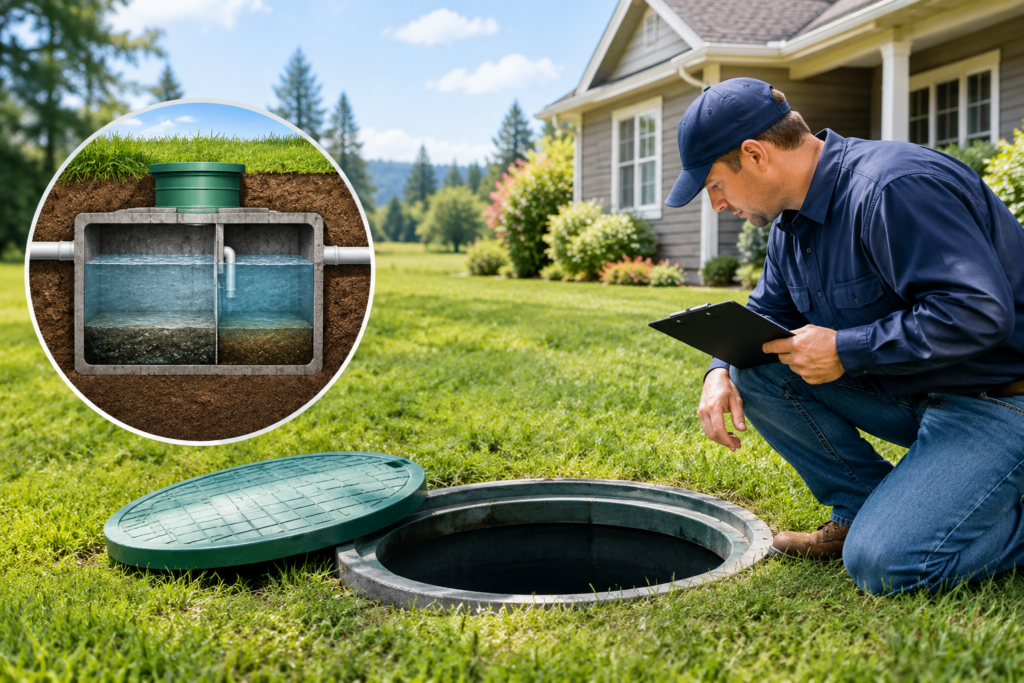
A septic tank doesn’t send a warning text before it starts failing. The process is chemical and gradual: solids settle, bacteria break down what they can, and the rest accumulates in layers that a homeowner has no way of seeing from the yard above. Industry inspectors actually work off a specific threshold – once combined sludge and scum reach about one-third of a tank’s liquid depth, the system is already past due for service, but nothing on the surface has changed. That’s the blind spot a professional septic inspection exists to close, and it’s the reason our team at Gateway Septic treats “working fine” as a starting point for the visit, not a reason to skip it.
This blog breaks down the specific measurements, components, and thresholds a septic system inspection actually checks, why a system can pass every visible test while quietly failing underground, and what our inspectors look for that most homeowners never would. You’ll also see how often Washington law requires this for gravity and pressurized systems alike.
A Septic System Can Have Problems Before You Notice Any Symptoms
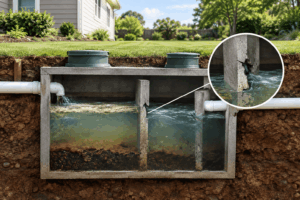
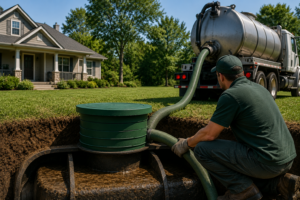
Septic professionals use a specific rule for when it’s time to pump a tank. When the sludge plus the scum layer is about one-third the working depth of the tank, or when the scum layer is within three inches of the bottom edge of the outlet baffle. No threshold can be seen without opening the tank and directly measuring it.
A homeowner has no equivalent early-warning system. Slow drains and sewage odors develop in the later stages, not the early stages. That’s why a routine septic inspection finds conditions that are measurable long before they become noticeable inside the house.
What Can a Septic Inspection Find Before a Failure?
Every component in a septic system degrades differently, and a thorough inspection accounts for each one separately rather than treating the system as a single unit. Three areas are prone to silent failure.
Signs of Tank Damage or Structural Deterioration
Concrete tanks develop hairline cracks as soil shifts around them, while steel tanks corrode internally from prolonged contact with acidic effluent. These specific failure patterns are what a septic tank inspection looks for in the tank walls, risers, and lids, and also the effluent filter, which traps solids before they reach the drainfield and, when clogged, causes whole-house slow drains that look like a tank problem instead of a filter problem.
Problems With Baffles, Lids, and Inlet or Outlet Pipes
Baffle systems direct the flow of wastewater and keep floating scum from going straight to the drainfield. If the outlet baffle is corroded or missing, solids can completely bypass the tank, and once that occurs, the damage is passed downstream to the soil itself. We also determine if dye testing is warranted, which involves our inspectors introducing a traceable dye into the plumbing to confirm where effluent is really going once it leaves the tank.
Drainfield Issues That May Not Be Visible Yet
The distribution box, or D-box, divides effluent evenly among the drainfield’s lateral lines. A D-box that is slightly tilted will overtax some lines and make others nearly dry. The imbalance accelerates failure in the overtaxed section long before stress shows up in the rest of the field. The only way to catch this before it becomes visible on the surface is often by scoping the lines that lead to the D-box.
| What a Homeowner Notices | What an Inspection Actually Measures |
| Nothing, lawn looks normal | D-box level, lateral line distribution |
| Drains seem fine | Sludge/scum depth against the one-third rule |
| No odor indoors | Effluent filter condition and baffle integrity |
| No standing water | Drainfield saturation via dye trace |
How Inspections Can Prevent Unexpected Septic Repair Costs
Solids that pass a failed baffle and enter the drainfield clog the soil’s absorption capacity by forming what is called a biomat, and that damage is irreversible. Typically, a drainfield with a compromised biomat layer needs to be rested or partially rebuilt. That is a much bigger job than replacing a baffle or cleaning an effluent filter.
This is the real argument for catching problems early: a septic system inspection cost is minor compared to what soil remediation or drainfield replacement demands, and unlike a tank component, damaged soil can’t simply be swapped out. But if you wait until solids have already migrated downstream, you’re not picking between repair options; you’re managing a problem that will only get worse until the field is addressed.
A clogged effluent filter costs you nothing to clean. A clogged drainfield costs you the field.
When Should You Inspect a Septic System That Seems Fine?
Washington’s Puget Sound Clean Water Act requires gravity septic systems to be inspected every three years, while pressurized and alternative systems typically require annual inspection because their mechanical components- pumps, floats, and control panels- wear out on a shorter timeline than a gravity system’s passive design. Property sales add a separate requirement regardless of when the last inspection took place.
We conduct inspections for gravity and pressurized systems for homeowners in Mount Vernon, Stanwood, Oak Harbor, and Sedro Woolley. The three-year clock does not stop because a system appears to be in working order. Miss that window, and you’re operating out of compliance with sludge and scum accumulating unmeasured.
What Happens During a Professional Septic Inspection?
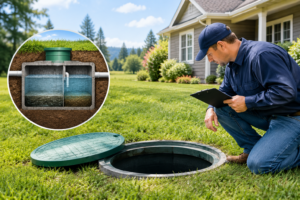
The inspection walks through the system step by step, beginning with the tank, then the components that transfer the effluent, and finally an evaluation of what actually needs to happen next. Each stage produces its own set of measurements, rather than a single pass/fail determination.
Checking the Tank and Its Accessible Components
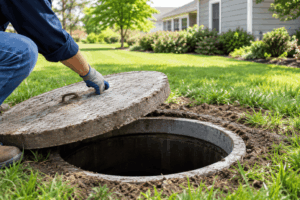
We open the tank and take a direct reading of the sludge depth with a sludge judge and check the scum thickness against the outlet baffle to apply the one-third rule correctly. The same step involves removing, inspecting, and cleaning the effluent filter, as a clogged filter can mimic symptoms of a much bigger problem.
Evaluating the System’s Condition and Performance
From there, we open the distribution box to confirm it’s level and distributing effluent evenly across every lateral line. Where the drainfield’s condition is uncertain, a dye test or camera scope of the connecting lines gives us a direct look rather than a guess.
Identifying Repairs That Actually Need Attention
Not every finding requires immediate action, and part of our job is differentiating between urgent repairs and components that just need monitoring. A working septic tank
inspection checklist typically includes:
- Sludge and scum depth measured against the one-third rule.
- Effluent filter condition and cleaning.
- Baffle integrity at both inlet and outlet.
- D-box level and lateral line distribution.
- Camera or dye-trace results where the drainfield’s condition is uncertain.
Is a Septic Inspection Worth the Cost if Nothing Is Wrong?
An inspection that finds nothing wrong still tells you something no amount of guessing can: your sludge and scum levels are within range, your baffles are intact, and your D-box is distributing evenly. One of our long-term clients has told us that on several occasions our inspections have proved a tank didn’t need pumping, avoiding an unnecessary service call, simply because the measurements, not assumptions, proved otherwise.
That documentation also matters beyond your own peace of mind. A clean report becomes part of your property’s record, useful for a future sale or simply for tracking your system’s condition over time. Skipping the inspection doesn’t make the tank’s sludge level stop rising; it just means nobody’s measuring it.
When an Inspection Gives You Peace of Mind
A septic system inspection measures exactly what a homeowner can’t see: sludge and scum against the one-third rule, baffle condition, D-box level, and drainfield performance. Catching a problem at this stage means replacing a filter or a baffle. Missing it means the damage moves into the soil, where it can’t simply be pumped away.
At Gateway Septic, we’ve served the greater Skagit area since 1976, and our septic inspection services apply this same measurement-based approach to every gravity and pressurized system we assess. Our team uses modern diagnostic tools, from sludge judges to camera scoping, and we’re upfront about exactly what we find and why it matters.
If it’s been close to three years since your last inspection, or you simply want documented proof of where your system stands, our team is ready to help. 360-826-5520