
Your drain field is the most expensive component of your septic system, and the one most homeowners ignore until it fails permanently. When untreated solids bypass the tank and reach it repeatedly, the soil seals shut with no viable path to restoration short of a full, costly replacement. The painful part? Most drain field failures trace back to one overlooked component, the septic tank effluent filter.
At Gateway Septic, we’ve seen this play out too many times across Skagit County, and we want every homeowner to understand what’s at stake before it’s too late.
This blog covers everything about the septic tank effluent filter: what a septic effluent filter is, how it functions to protect your system, the types available, warning signs to watch for, and why professional maintenance matters.
What Is a Septic Tank Effluent Filter?
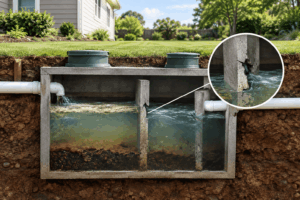
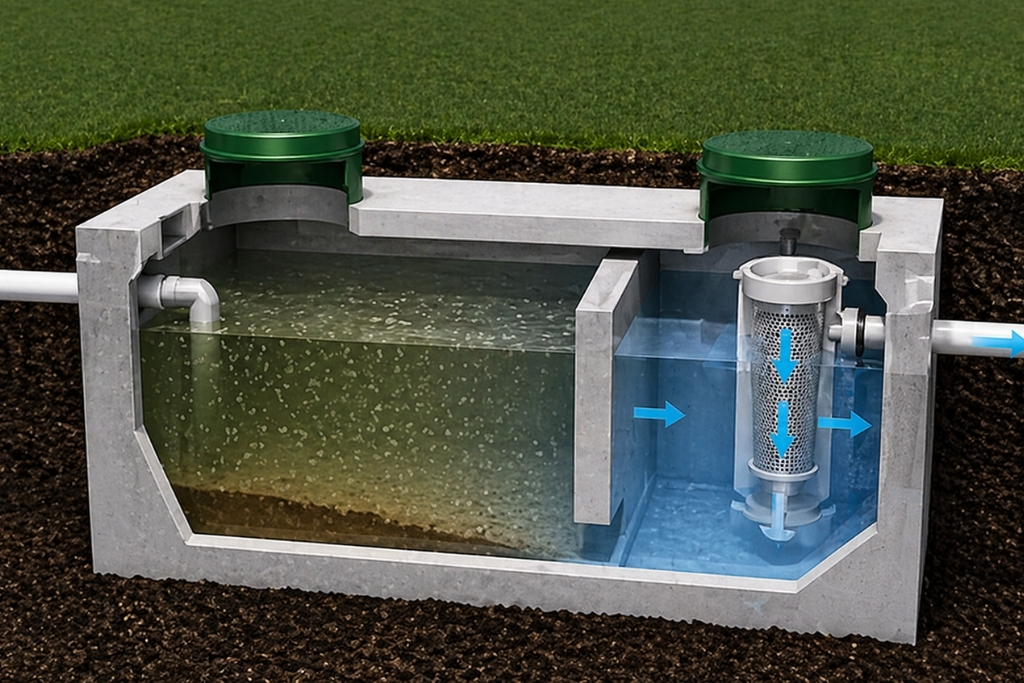
Most homeowners can name a septic tank. Few can identify the cylindrical cartridge within its outlet baffle, the component performing the most difficult and least-glorified job in the system.
A septic tank effluent filter is a screened device, typically 4–6 inches in diameter, positioned at the tank outlet where treated wastewater exits toward the drain field. Its slots, usually 1/16 to 1/8 inch wide, allow liquid through while blocking solid particles that escaped the tank’s natural settling process.
What Does It Actually Intercept?
Effluent leaving a tank is never perfectly clean. It carries toilet paper fragments, hair and lint, grease particles, fine organic solids, and grit. In the absence of a filter, all particles flow straight into your drain field pipes, forming a dense bacterial mat, also known as a biomat. This mat effectively blocks the soil’s ability to absorb, causing irreversible damage.
Many older systems, particularly those installed before 2000, were never equipped with effluent filters. If your system falls in that category, it is not protected.
Why Is a Septic Effluent Filter Important for Your Septic System?
The septic tank filter purpose isn’t just about keeping pipes clear. It’s about saving a biological process that can’t be undone once it is damaged.
When fine solids reach the drain field repeatedly, they accelerate biomat buildup until the soil can no longer absorb effluent. Wastewater then surfaces in the yard, backs up into the home, and the drain field must be fully replaced. NOWRA (National Onsite Wastewater Recycling Association) research confirms that effluent filters significantly reduce suspended solids that reach drain fields, directly slowing biomat formation and preserving long-term soil percolation.
Beyond protecting your property, a functioning filter protects groundwater. In rural Skagit County, across Mount Vernon, Stanwood, Oak Harbor, and Sedro Woolley, residential septic systems sit above the same aquifers many households drink from. A failing system without a filter isn’t just a property problem. It’s a public health concern.
No filter. No barrier. No second chances once the drain field is gone.
How Does a Septic Effluent Filter Work?
The septic effluent filter function is mechanical, no electricity, no chemicals, no moving parts. Effluent flows from the tank toward the outlet. When it goes to exit, it has to go through the filter slotted cartridge. Any particles larger than the width of the slot are returned back into the tank, where they stay until the next pump-out. Only liquid is directed to the drain field.
| Stage | What Happens |
| Wastewater enters tank | Raw sewage flows in from the home |
| Settling occurs | Heavy solids sink; grease rises as scum |
| Effluent layer forms | Liquid in the middle is ready to exit |
| Filter intercepts solids | Cartridge screens particles before the outlet |
| Clean effluent exits | Filtered liquid enters the drain field safely |
One important detail: A clogging filter causes wastewater to back up into your home first. That’s the design working as intended. Your warning is the backup. But if left unchecked long enough, pressure will force unfiltered effluent to bypass the filter and flow directly into the drain field. That’s the worst possible outcome.
Types of Septic Tank Effluent Filters
The right filter will depend on the size of your tank, your household water use, and the age of your system.
- Slot Filter: The most widely installed type. Easy to clean and compatible with most residential tanks. Standard choice for typical Skagit County households.
- Mesh Filters: Finer filtration for higher-usage homes, but they clog faster and need more frequent cleaning.
- Brush-Style Filters: Designed for homes with garbage disposals. More durable, more aggressive at trapping grease and fine organics.
- Alarm-Equipped Filters: Include a float alarm that triggers before a full clog develops. Ideal for seasonal properties or owners who want early warning without relying on indoor symptoms.
The wrong filter is nearly as problematic as no filter at all. Our team at Gateway Septic helps homeowners across Stanwood, Oak Harbor, Sedro Woolley, and Mount Vernon select the right fit for their specific system.
Signs Your Septic Effluent Filter Is Clogged or Needs Cleaning
And right there, most homeowners miss the window. The early signs are silent. By the time they’re visible, damage is already underway.
Early Warning Signs
- Multiple drains are slowing simultaneously; a single slow drain is a pipe clog; all drains slowing at once point to the filter or tank
- Gurgling sounds from toilets or floor drains after water use
- Faint sewage odor near the tank access area
Escalating Signs: Act Immediately
- Sewage is backing up into the lowest fixtures in the home
- Standing water or unusually saturated soil near the drain field
- Persistently lush, dark green grass directly over the drain field trenches
The risk of waiting: A clogged filter doesn’t stay clogged; it eventually forces effluent through unfiltered. Solids then reach the drain field in volume, and the damage compounds with every flush. There is no point at which it self-corrects.
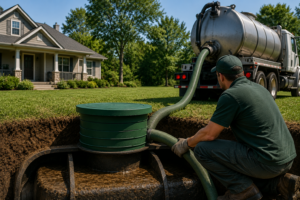
Preventive measure: Have your filter inspected at every pump-out. If you have four or more people in your household or use a garbage disposal, annual cleaning is the right standard for responsible septic system maintenance.
Think of the effluent filter like an oil filter in your car. Skip the maintenance long enough, and the engine, or in this case, your drain field, pays the price.
Benefits of Installing a Septic Tank Effluent Filter
Adding a filter is one of the top upgrades you can do for systems built before the widespread code requirements, most pre-2000 construction.
- Drain field protection: The most direct defense against premature drain field failure
- Extended system lifespan: Systems with maintained filters consistently outlast those without
- Groundwater safety: Prevents pathogens and suspended solids from entering the soil profile
- Code compliance: Many Washington State counties now require them on new installations and upgrades
- Early problem detection: A clogged filter causing backups, if detected early, becomes a manageable signal rather than a crisis.
Professional Septic Effluent Filter Installation and Maintenance
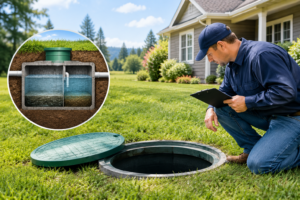
Installing or cleaning an effluent filter means working over an open septic tank with exposure to hydrogen sulfide and methane, not a weekend DIY job. State health agencies and manufacturers consistently recommend professional service for this reason.
What Professional Maintenance Covers
- Safe tank access and cartridge removal
- Cleaning with pressurized water, directed back into the tank, never onto the surrounding soil
- Inspecting the housing, end caps, and slots for cracks or structural failure
- Confirming proper seating and outlet baffle condition on reinstallation
- Replacement recommendation when the cartridge is beyond cleaning
Maintenance Schedule at a Glance
| Household Profile | Recommended Cleaning Frequency |
| 1–2 occupants, no garbage disposal | Every 2–3 years |
| 3–4 occupants | Every 1–2 years |
| 5+ occupants or garbage disposal in use | Annually |
| Any household | At every scheduled pump-out |
With proper care, filters usually last 10-15 years before needing to be replaced. At Gateway Septic, our team handles every aspect of septic system maintenance with the same standard we’d hold for our own homes. With nearly five decades of experience serving Mount Vernon, Stanwood, Oak Harbor, and Sedro Woolley, we know these systems, and we give homeowners honest answers, not upsells.
The Last Line of Defense: Make Sure It Holds
Every day, a septic tank effluent filter does its job, and your drain field is protected. Every day it goes uncleaned or absent, solids accumulate where recovery requires full replacement. The septic effluent filter function is simple, but its failure is anything but.
Responsible septic system maintenance comes down to this: know your system, inspect your filter, and don’t wait for a backup to prompt action. The septic tank filter purpose is to protect one of the most expensive components on your property, and routine filter care is the lowest-cost way to do exactly that.
Gateway Septic has been serving the families and businesses of Skagit County since 1976 as neighbors, not just service providers. From filter cleaning and inspections to complete system maintenance, we bring transparent pricing and genuine expertise to every job across Mount Vernon, Stanwood, Oak Harbor, and Sedro Woolley.
If you’re unsure when your filter was last serviced, or even if your system has a filter, it’s a question worth a call. Reach us at 360-826-5520, and we’ll take it from there.