
Every septic tank relies on one fitting to decide what leaves it and what stays behind. When that fit fails, when it corrodes or gets out of place, the tank has failed to separate solids from liquids, and the whole pipe and drain lines downstream suffer the consequences. Most homeowners don’t even know this part exists until a technician points it out during an inspection, and by then the damage has often already made it to the drainfield. Gateway Septic has spent decades catching this exact failure before it turns into a far larger project.
This blog breaks down what a septic baffle actually does, the specific clearance rules it has to meet under Washington’s own septic code, and what happens underground once it starts to fail. We will also go over the warning signs that are worth acting on immediately and when to schedule an inspection before a simple fix in Mount Vernon, Stanwood, Oak Harbor, or Sedro Woolley becomes a full drainfield repair.
What Is a Septic Tank Baffle and Why Does It Matter?
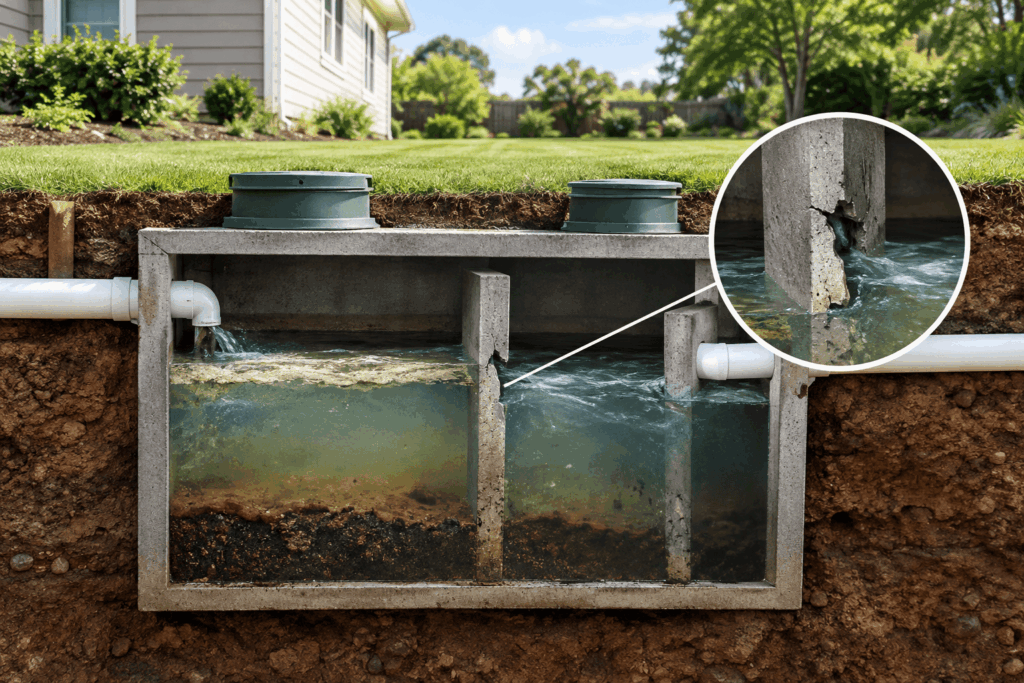
A septic system baffle is a T-shaped fitting at the tank’s inlet and outlet pipes, and its dimensions are far more regulated than most homeowners realize. Washington’s on-site sewage code says the outlet baffle, or sanitary tee, in a standard cylindrical tank must dip below the liquid surface by 25 to 35 percent of the tank’s liquid depth. The inlet baffle has a rule of its own: a minimum of eight inches below the liquid level, with the top up to the crown of the inlet pipe.
Those numbers aren’t arbitrary. If the outlet baffle is submerged too shallowly, floating scum will slip under it into the drainfield. If you go in too deep, you’ll suck up and out settled sludge. Washington also requires an effluent filter to be installed directly into the outlet baffle on approved tanks, adding a second level of solids control in addition to the baffle itself.
A baffle installed even a few inches outside that range can let solids escape years before anyone notices a symptom above ground.
What Happens Underground When a Septic Baffle Starts to Fail?
Failure rarely starts as a dramatic break. It starts with something much slower and much less visible, which is why so much damage occurs before a homeowner ever suspects a problem.
Concrete Baffles and Sulfide Corrosion
Older concrete baffles fail through the mechanism of microbially induced corrosion. Bacteria in the tank turn the hydrogen sulfide gas into sulfuric acid on the concrete surface, and over the course of years, that acid eats away at the material until the baffle crumbles or breaks free completely. The process is sped up in tanks that have long periods between pump-outs, as the build-up of gas increases with the depth of the sludge.
Plastic and PVC Baffle Failure Points
The newer plastic and PVC baffles don’t corrode in the same way, but they fail in different ways. Hard equipment pumping too hard can crack the fitting along its seam, and a tee that does not seat well can work loose from vibration or settling of the ground. Once separated even slightly from its housing, a broken septic tank baffle stops directing flow altogether.
Once either type fails, the tank effectively loses its ability to hold solids back, and every gallon that leaves the tank afterward carries more waste than it should.
How a Damaged Outlet Baffle Can Affect the Drainfield
The outlet side carries the highest risk by far. A damaged septic baffle on the outlet allows scum and solids to bypass the settling process in the tank and go directly to drainfield pipes that were designed to handle only liquid effluent.
Inspectors use a specific measurement to catch this before it becomes serious: if the sludge layer is within twelve inches of the bottom of the outlet baffle, or the scum layer is less than three inches above it, service is needed immediately. Beyond that point, solids start going through with every flush.
Once solids reach the soil, they form a biomat, a dense organic layer that clogs the pores water is supposed to pass through. If you have a drainfield with a biomat already, it doesn’t recover with pumping or chemicals. In many cases, the damaged section has to be rested for years or totally replaced.
| Healthy Outlet Baffle | Failing Outlet Baffle |
| Solids stay in the tank, only clarified liquid exits | Solids and scum pass directly into the drainfield |
| Sludge stays 12+ inches below the baffle | Sludge or scum crowds the baffle opening |
| Drainfield soil absorbs effluent normally | Biomat forms, and soil absorption slows or stops |
| System lifespan tracks toward 20-30 years | Drainfield section may need early replacement |
What Causes Septic Tank Baffles to Fail?
Septic tank baffle problems almost always trace back to one of two categories: the material itself breaking down, or something physical disrupting the fitting’s position.
Material Degradation
- Concrete baffles corroding from sulfide gas exposure over 15 to 25 years.
- PVC fittings cracking at stress points after repeated pumping cycles.
- Gaskets and seals hardening and losing their grip over time.
Installation and Mechanical Damage
- A baffle installed outside the required submergence range from the start.
- Rodding equipment or pumping hoses striking and dislodging the fitting.
- Tree roots working into aging tank seams and pushing fittings out of alignment.
- Sludge that’s built up past a third of the tank’s liquid depth, adding sustained pressure against the baffle.
Signs That Your Septic Tank Baffle May Be Failing
The baffle is underground, so you never get to see it fail directly. Instead, you get downstream effects that are pointing to different stages of the same underlying problem.
Slow Drains or Recurring Plumbing Problems
If tubs and sinks are draining slower than usual, and there is no indoor clog to explain it, the sludge has probably migrated to the outlet. On its own, this pattern usually gets worse, not better.
Unusual Odors Around the Tank or Drainfield
A properly sealed system keeps sewage gas contained. Odors escaping near the tank lid or drainfield mean gas and, often, solids are finding a path out through a septic tank outlet baffle that’s no longer sealing correctly.
Wet or Unusually Green Areas Near the Drainfield
Bright, spongy grass over the drainfield, even during dry weather, means effluent is surfacing instead of absorbing into the soil below. If this sign is ignored, the biomat behind this sign will continue to grow.
Repeated Septic Backups Despite Regular Pumping
If backups continue soon after a pump-out, the baffle is more likely the problem, not the pumping schedule. Pumping empties the tank. It doesn’t do anything to fix a fitting that’s already cracked, corroded, or missing.
When Should You Have Your Septic Baffles Inspected?
Baffles should be inspected when the tank is opened for pumping, not on a separate visit. And since the tank is already empty, a technician can take sludge and scum readings directly against the baffle and catch a problem at the twelve-inch mark before it becomes a drainfield problem.
An inspection makes sense beyond routine pumping, before a property sale, after any major plumbing work on the home, and immediately if any of the warning signs above appear. Waiting for the next scheduled pump-out once symptoms start is often the difference between a septic baffle repair and a full septic tank baffle replacement.
The Bottom Line on Baffle Health
A septic baffle is a small, code-regulated fitting with an outsized job, and its failure rarely announces itself until solids have already reached the drainfield. Almost every failure underground, from the depths of submergence required by Washington’s septic code to the sulfide corrosion that slowly eats concrete fittings away, follows a predictable pattern and is inexpensive to correct if caught early.
At Gateway Septic, we’ve served Skagit County since 1976, and every pump-out our team performs includes a direct check of both baffles against the depth and clearance standards outlined above, not just a routine emptying of the tank. We handle everything from septic tank baffle repair to complete septic system baffle work, alongside our regular inspection, installation, and maintenance services, using only components we’d trust in our own systems.
If you’re noticing odors, slow drains, or a wet spot near your drainfield anywhere from Mount Vernon to Stanwood, Oak Harbor, or Sedro Woolley, don’t wait for the next scheduled pump-out to find out how far the damage has spread. Call Gateway Septic at 360-826-5520 to schedule an inspection before a small septic tank baffle failure becomes a drainfield you have to replace.